Free practice, no account needed
NC Math 1 EOC practice questions, free
These 28 questions are the free sample pages of our NC Math 1 EOC test-prep book, written in the format of the NC Math 1 End-of-Course test. Chapter 1 is calculator-inactive and Chapter 2 is calculator-active, as on the test. Try each one, then open its answer and worked solution.
For the state's own questions, NC DPI publishes a released NC Math 1 form on its End-of-Course (EOC) page, and the full released forms in its NCTest portal. Back to NC EOC test prep.
Chapter 1: calculator inactive
Question 1
Given the functions and , what is the value of the expression ?
Show the answer
Answer: 24
Solution: and , so .
Question 2
What is the sum of the zeros of the quadratic function that has the factors and ?
- A.
- B.
- C.
- D.
Show the answer
Answer: A ()
Solution: Set each factor to zero: and . The sum is .
Question 3
The formula gives the electric power as a function of the current and resistance . What is the equation for the current as a function of the power and resistance ?
- A.
- B.
- C.
- D.
Show the answer
Answer: D ()
Solution: Divide both sides by : . Take the square root (current is positive): .
Question 4
What are the coordinates of the vertex of the quadratic function that has the factors and ?
- A.
- B.
- C.
- D.
Show the answer
Answer: B ()
Solution: The zeros are and , so the vertex is halfway between them at . Then , giving .
Question 5
Given the function . What is the value of the vertex?
Show the answer
Answer: 5
Solution: Here and , so .
Question 6
What is the positive solution of the equation ?
Show the answer
Answer: 3
Solution: Subtract 3: , which factors as . The solutions are and ; the positive one is .
Question 7
Given the equations: What is the value of ?
Show the answer
Answer: 12
Solution: Substitute : , so and . Then (also directly: dividing the first equation by 3 gives ).
Question 8
Given the function , what is the positive zero of this function?
Show the answer
Answer: 1.5
Solution: Set to get (the other zero, , is negative).
Question 9
Given the functions and , what is the value of the expression ?
Show the answer
Answer: 2
Solution: and , so .
Question 10
Given the equation , what is the value of ?
Show the answer
Answer: 4
Solution: Add exponents in the numerator and subtract the denominator's: , so .
Question 11
The endpoints of one side of a square are located at and . What is the area of this square?
Show the answer
Answer: 25
Solution: The side length is , so the area is .
Question 12
Given the functions and , what is the value of the expression ?
Show the answer
Answer: 4
Solution: , so .
Question 13
Given the function , what is the smaller zero of this function?
Show the answer
Answer: 0.5
Solution: Factor: . The zeros are and ; the smaller is .
Question 14
Given the function , what is the -coordinate of the point where the graph of intersects the -axis?
Show the answer
Answer: 4
Solution: The graph meets the -axis where : .
Question 15
Given the equations: What is the value of so the system above has no solution?
Show the answer
Answer: -3
Solution: No solution means parallel lines: the coefficients must be proportional, , so . Then the first equation times 3 is , which contradicts .
Question 16
Given the function , what is the positive zero of this function?
Show the answer
Answer: 14
Solution: , so ; the positive zero is .
Question 17
What is the sum of the zeros of the function ?
Show the answer
Answer: -3
Solution: Factor: , so the zeros are and , and their sum is (also ).
Question 18
What is a quadratic function that has the zeros and ?
- A.
- B.
- C.
- D.
Show the answer
Answer: D ()
Solution: The factors are and : .
Question 34
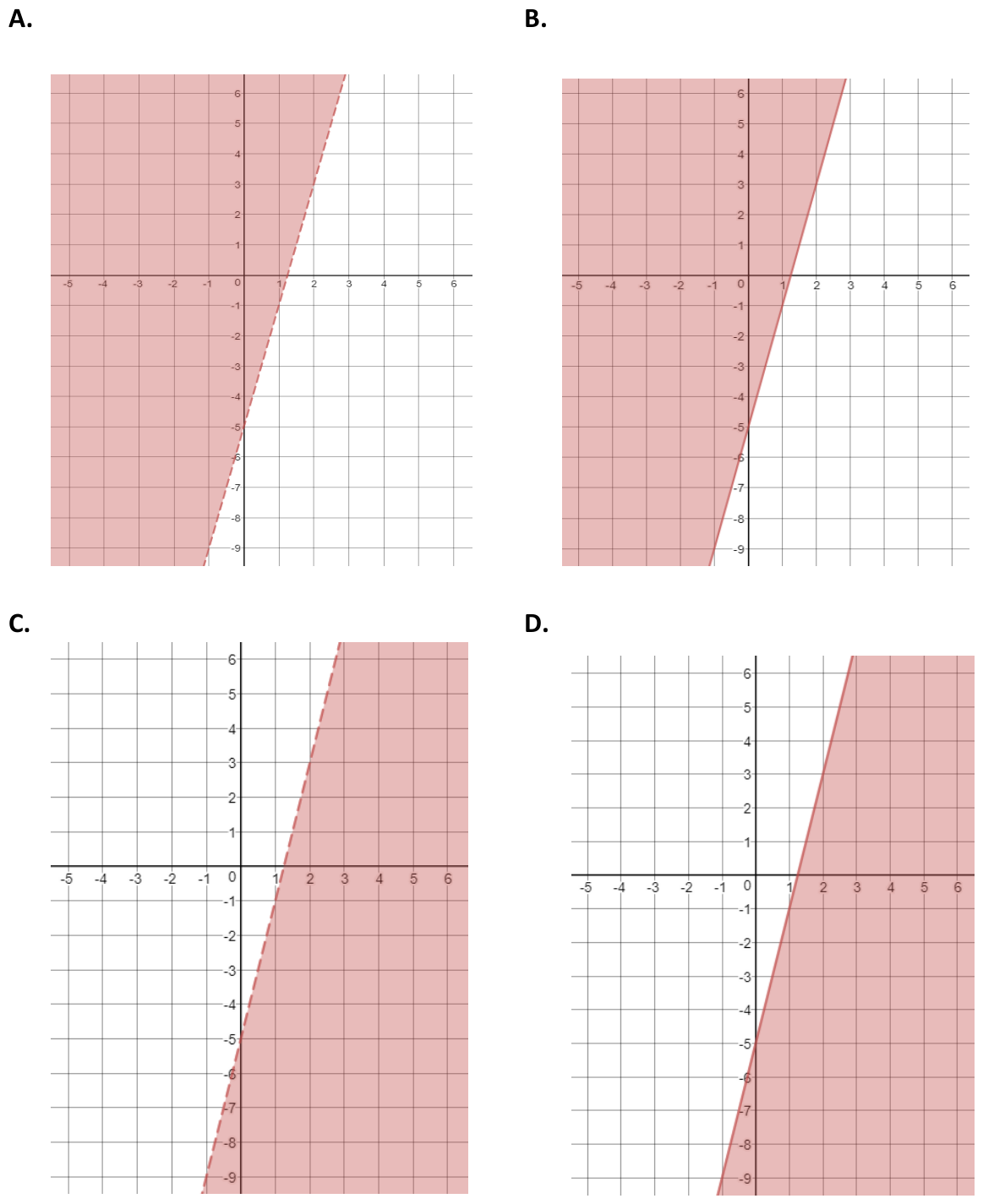
What is the solution of the inequality ?
Show the answer
Answer: D (Graph D: solid line through (0, -5) and (2, 3), shaded below and to the right of the line)
Solution: Solve for : , so . The boundary line has -intercept and slope 4, it is solid because of , and the shading is below the line (the origin does not satisfy the inequality, since is false). That is graph D.
Question 35
A factory models its net income (in thousands of dollars) with the function , where is the number of units sold. How many units do they have to sell in order for the income to equal $0?
Show the answer
Answer: 8
Solution: Set and divide by 7: , so . The number of units cannot be negative, so .
Question 36
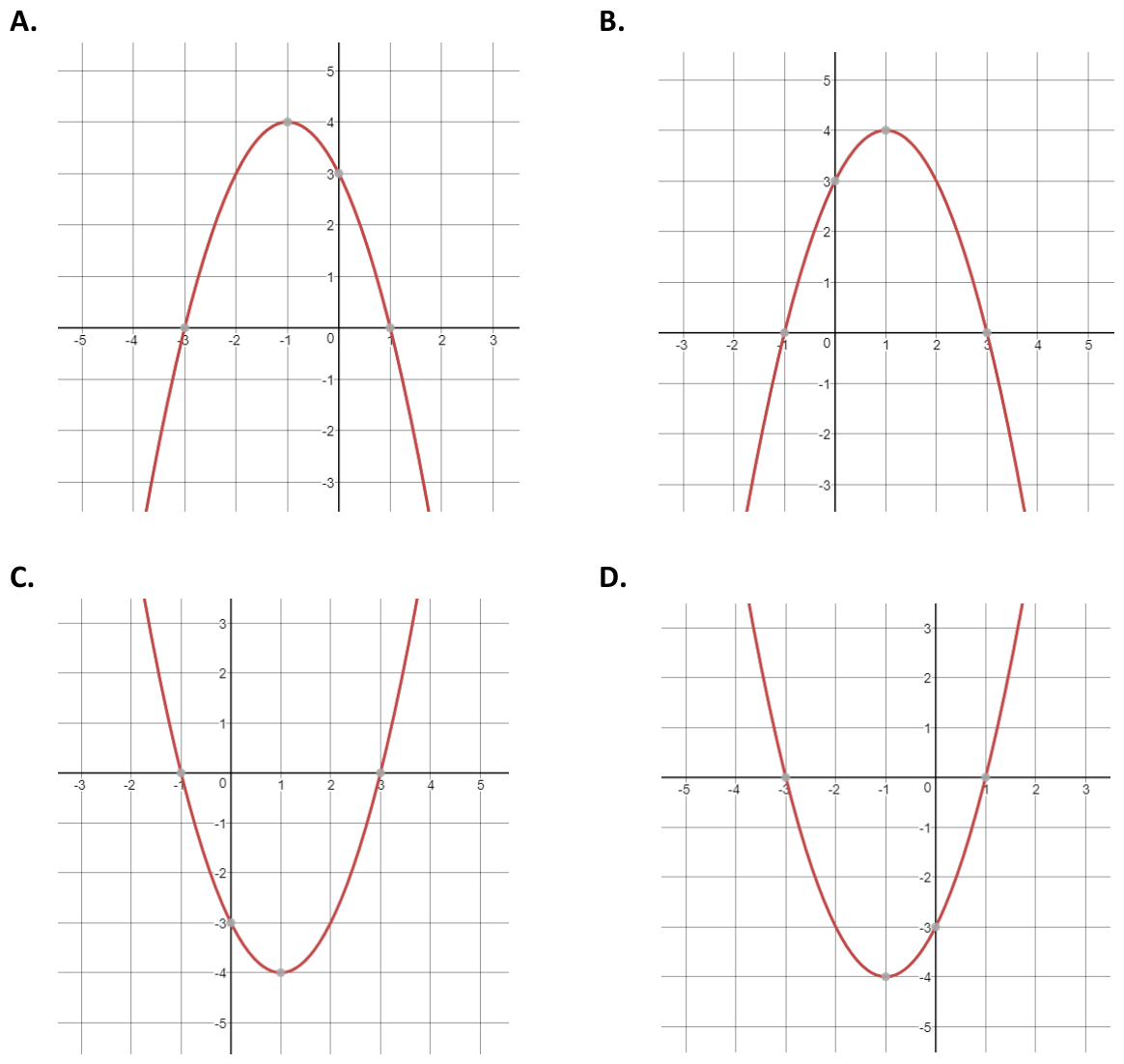
What is the graph of the function ?
Show the answer
Answer: B (Graph B: downward parabola with vertex (1, 4), zeros at -1 and 3, y-intercept 3)
Solution: The zeros are and , and expanding gives , so the parabola opens down with -intercept 3. The vertex is at , . Graph B is the downward parabola through , , and .
Question 37
Maria is renting a car. The function models the cost to rent a car from Company A and drive it miles. The function models the cost to rent a car from Company B and drive it miles. Maria will drive the car 80 miles. How much will Maria save if she rents the car from Company B rather than from Company A?
Show the answer
Answer: 8
Solution: Company A: . Company B: . She saves dollars.
Question 38
At a pizza restaurant a large pizza costs 2 times as much as a small pizza. Paul purchased 4 small pizzas and 3 large pizzas for a total of $60. How much does a small pizza cost?
Show the answer
Answer: 6
Solution: Let a small pizza cost ; a large costs . Then , so dollars.
Question 39
The height of a ball seconds after being launched into the air can be modeled by the equation . After how many seconds does the ball hit the ground?
Show the answer
Answer: 5
Solution: The ball hits the ground when : , so and . Time cannot be negative, so it lands after 5 seconds.
Chapter 2: calculator active
Question 1
Which expression is equivalent to ?
- A.
- B.
- C.
- D.
Show the answer
Answer: C ()
Solution: and . Multiply by adding exponents: .
Question 2
The table below shows the lengths and the weights of some bottlenose dolphins. Using a linear best-fit model for the data, what is the approximate correlation coefficient?
Length (feet) Weight (tons) 35 15 37 18 40 20 41 22 46 28 49 23 50 35 - A.
- B.
- C.
- D.
Show the answer
Answer: C ()
Solution: Entering the data in a calculator and running a linear regression gives , which rounds to .
Question 3
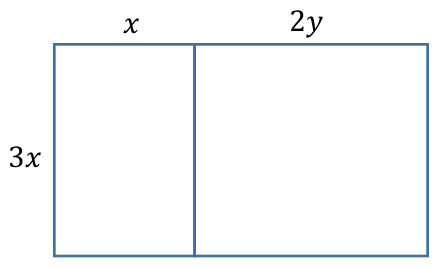
What is the total area in terms of and ?
- A.
- B.
- C.
- D.
Show the answer
Answer: C ()
Solution: The whole figure is a rectangle tall and wide, so the area is (the two parts are and ).
Question 4
Which equation represents the line that is perpendicular to the graph of and passes through ?
- A.
- B.
- C.
- D.
Show the answer
Answer: B ()
Solution: The given line has slope , so a perpendicular line has slope . Through : , so , which is .
Common questions
- Are these real NC Math 1 EOC questions?
- No. They are practice questions from the Successful Mathematics NC Math 1 EOC test-prep book, written in the format of the End-of-Course test. NC DPI publishes its own released Math 1 form on its End-of-Course (EOC) page.
- Where are the rest of the questions?
- The printed book holds 400 cumulative review questions covering the whole Math 1 course: 200 calculator-inactive in Chapter 1 and 200 calculator-active in Chapter 2, with a complete answer key. The COGENT Math 1 course also ends with an End-of-Course Test Prep unit: 15 practice sets and a 40-question End-of-Course Exam.
- Do I need an account to use these?
- No. Every question, answer and solution on this page is free to read and use.