Free practice, no account needed

NC Math 3 EOC practice questions, free

These 36 questions are the free sample pages of our NC Math 3 EOC test-prep book. They are find-the-answer questions, from polynomials to circle geometry. Try each one, then open its answer and worked solution.

For the state's own questions, NC DPI publishes a released NC Math 3 form on its End-of-Course (EOC) page, and the full released forms in its NCTest portal. Back to NC EOC test prep.

Questions 1-25: polynomials, rational equations and circles

  1. Question 1

    Find the zeros of the function and state their multiplicity: f(x)=(x−1)3(x2+4)(x+2)f(x) = (x - 1)^3(x^2 + 4)(x + 2)

    Show the answer

    Answer: x=1x = 1 (multiplicity 3); x=−2x = -2 (multiplicity 1); x=±2ix = \pm 2i (multiplicity 1)

    Solution: (x−1)3(x - 1)^3 gives x=1x = 1 three times, (x+2)(x + 2) gives x=−2x = -2 once, and x2+4=0x^2 + 4 = 0 gives x=±2ix = \pm 2i, each once.

  2. Question 2

    Find the zeros of the function and state their multiplicity: f(x)=(x2−1)4(x+1)(x2+2x−3)3f(x) = (x^2 - 1)^4(x + 1)(x^2 + 2x - 3)^3

    Show the answer

    Answer: x=−1x = -1 (multiplicity 5); x=1x = 1 (multiplicity 7); x=−3x = -3 (multiplicity 3)

    Solution: Factor: (x2−1)4=(x−1)4(x+1)4(x^2 - 1)^4 = (x - 1)^4(x + 1)^4 and (x2+2x−3)3=(x+3)3(x−1)3(x^2 + 2x - 3)^3 = (x + 3)^3(x - 1)^3. So x=1x = 1 appears 4+3=74 + 3 = 7 times, x=−1x = -1 appears 4+1=54 + 1 = 5 times, and x=−3x = -3 appears 3 times.

  3. Question 3

    How many complex solutions does the function f(x)=3x4+2x2−5f(x) = 3x^4 + 2x^2 - 5 have? How many of these solutions are real?

    Show the answer

    Answer: 4 complex solutions; 2 real solutions

    Solution: The degree is 4, so there are 4 complex solutions. Factor: (3x2+5)(x2−1)(3x^2 + 5)(x^2 - 1); x2−1x^2 - 1 gives the real solutions ±1\pm 1 and 3x2+53x^2 + 5 gives two non-real ones.

  4. Question 4

    How many complex solutions does the function f(x)=x4+2x3−2x2+2x−3f(x) = x^4 + 2x^3 - 2x^2 + 2x - 3 have? How many of these solutions are real?

    Show the answer

    Answer: 4 complex solutions; 2 real solutions

    Solution: The degree is 4, so there are 4 complex solutions. It factors as (x−1)(x+3)(x2+1)(x - 1)(x + 3)(x^2 + 1): real solutions 11 and −3-3, and ±i\pm i are not real.

  5. Question 5

    What is the lowest possible degree of the polynomial function graphed below?
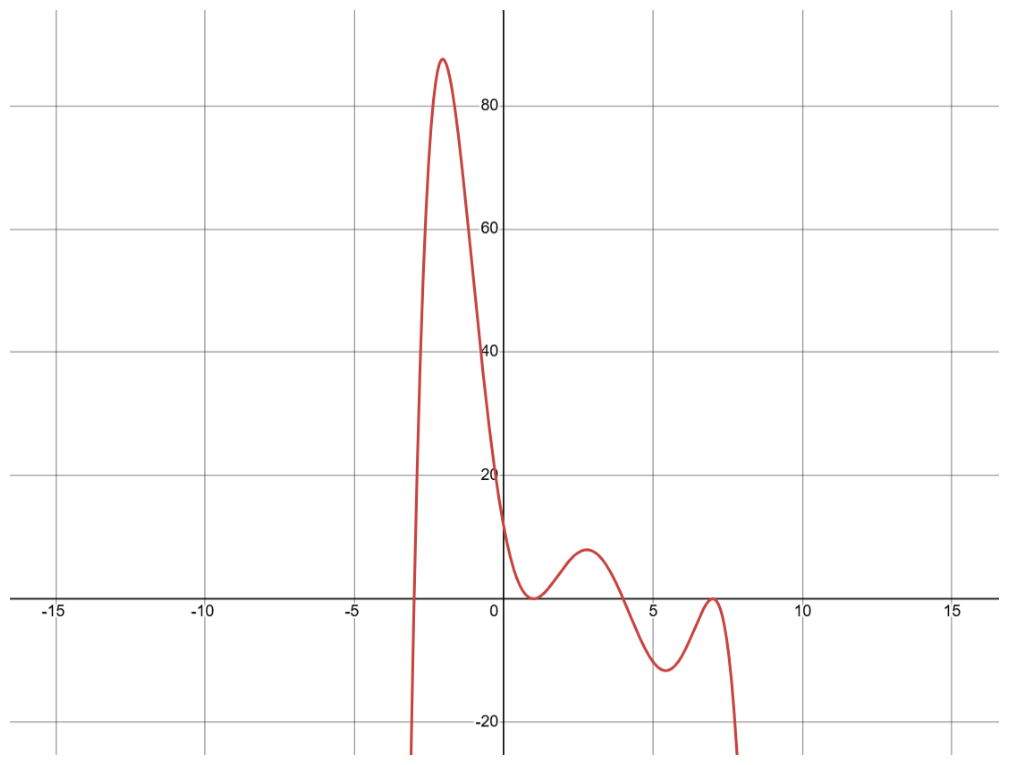
    Graph of a polynomial on a grid with x from -15 to 15 and y from about -25 to 90. Coming up from the bottom, the curve crosses the x-axis near x = -3, rises steeply to a peak of about 87 near x = -1.8, falls to touch the x-axis at x = 1 and turns back up, rises to a small peak of about 8 near x = 3, crosses the x-axis near x = 4, dips to about -11 near x = 5.5, rises to touch the x-axis at about x = 7, then falls down off the bottom of the grid. Both ends point downward.
    Show the answer

    Answer: 6

    Solution: The graph has 5 turning points (a high peak near x≈−1.8x \approx -1.8, a low point touching the axis at x=1x = 1, a peak near x≈3x \approx 3, a low point near x≈5.5x \approx 5.5, and a peak touching the axis near x=7x = 7), so the degree is at least 5+1=65 + 1 = 6. Counting zeros with multiplicity gives the same: crosses near −3-3 and 44 (1 each), touches at 11 and 77 (2 each), 1+2+1+2=61 + 2 + 1 + 2 = 6. Both ends go down, which fits an even degree.

  6. Question 6

    The price per day, in dollars, that a parking garage is charging is given by the function: p(t)={0,0≤t≤510,5<t≤6018,60<t≤12024,120<t≤18030,t>180p(t) = \begin{cases} 0, & 0 \le t \le 5 \\ 10, & 5 < t \le 60 \\ 18, & 60 < t \le 120 \\ 24, & 120 < t \le 180 \\ 30, & t > 180 \end{cases}, where tt is the time in minutes.

    What is the cost for 120-minute parking in the garage?

    Show the answer

    Answer: $18

    Solution: t=120t = 120 falls in 60<t≤12060 < t \le 120, so p(120)=18p(120) = 18 dollars.

  7. Question 7

    The price per day, in dollars, that a parking garage is charging is given by the function: p(t)={0,0≤t≤510,5<t≤6018,60<t≤12024,120<t≤18030,t>180p(t) = \begin{cases} 0, & 0 \le t \le 5 \\ 10, & 5 < t \le 60 \\ 18, & 60 < t \le 120 \\ 24, & 120 < t \le 180 \\ 30, & t > 180 \end{cases}, where tt is the time in minutes.

    What is the maximum amount that someone would pay for parking per day?

    Show the answer

    Answer: $30

    Solution: The largest value the function takes is 30, for any time over 180 minutes.

  8. Question 8

    George invests a certain amount of money into a bank that offers a return on investment based on the function f(t)=5000(1.035)4tf(t) = 5000(1.035)^{4t}, where tt is the time in years.

    What is the initial amount of money that George invested?

    Show the answer

    Answer: $5,000

    Solution: At t=0t = 0, f(0)=5000(1.035)0=5000f(0) = 5000(1.035)^0 = 5000 dollars.

  9. Question 9

    George invests a certain amount of money into a bank that offers a return on investment based on the function f(t)=5000(1.035)4tf(t) = 5000(1.035)^{4t}, where tt is the time in years.

    What is the annual interest rate that the bank offers and how often is it compounded?

    Show the answer

    Answer: 14% compounded quarterly

    Solution: The form P(1+rn)ntP\left(1 + \frac{r}{n}\right)^{nt} matches with n=4n = 4 (quarterly) and rn=0.035\frac{r}{n} = 0.035, so r=4(0.035)=0.14=14%r = 4(0.035) = 0.14 = 14\%.

  10. Question 10

    John and Aaron would like to complete a task together. If John would work on the task by himself, it would take him 25 minutes to complete it. The equation below determines the number of minutes it would take Aaron to complete the task by himself: 125+1x=120\frac{1}{25} + \frac{1}{x} = \frac{1}{20} What is the meaning of the denominator 20 in the equation?

    Show the answer

    Answer: Number of minutes it would take to complete the task if they work together

    Solution: Each fraction is a rate in tasks per minute: John does 125\frac{1}{25}, Aaron does 1x\frac{1}{x}, and together they do 120\frac{1}{20} of the task per minute, so 20 is the time working together.

  11. Question 11

    In the equation of the circle (x+4)2+(y−5)2=9(x + 4)^2 + (y - 5)^2 = 9, what does the 4 represent?

    Show the answer

    Answer: The opposite of the xx-coordinate of the center of the circle

    Solution: The standard form is (x−h)2+(y−k)2=r2(x - h)^2 + (y - k)^2 = r^2. Here x+4=x−(−4)x + 4 = x - (-4), so h=−4h = -4, and the 4 is the opposite of the center's xx-coordinate.

  12. Question 12

    Given the function: f(x)={−x2+4,x<−17−3x,−1≤x<3∣2−x∣,x≥3f(x) = \begin{cases} -x^2 + 4, & x < -1 \\ 7 - 3x, & -1 \le x < 3 \\ |2 - x|, & x \ge 3 \end{cases}

    What is the value of f(−1)f(-1)?

    Show the answer

    Answer: 10

    Solution: x=−1x = -1 is in −1≤x<3-1 \le x < 3, so f(−1)=7−3(−1)=10f(-1) = 7 - 3(-1) = 10.

  13. Question 13

    Given the function: f(x)={−x2+4,x<−17−3x,−1≤x<3∣2−x∣,x≥3f(x) = \begin{cases} -x^2 + 4, & x < -1 \\ 7 - 3x, & -1 \le x < 3 \\ |2 - x|, & x \ge 3 \end{cases}

    What is the value of f(7)f(7)?

    Show the answer

    Answer: 5

    Solution: x=7x = 7 is in x≥3x \ge 3, so f(7)=∣2−7∣=5f(7) = |2 - 7| = 5.

  14. Question 14

    Given the function: f(x)={−x2+4,x<−17−3x,−1≤x<3∣2−x∣,x≥3f(x) = \begin{cases} -x^2 + 4, & x < -1 \\ 7 - 3x, & -1 \le x < 3 \\ |2 - x|, & x \ge 3 \end{cases}

    What is the value of f(−2)f(-2)?

    Show the answer

    Answer: 0

    Solution: x=−2x = -2 is in x<−1x < -1, so f(−2)=−(−2)2+4=0f(-2) = -(-2)^2 + 4 = 0.

  15. Question 15

    Given the function: f(x)={−x2+4,x<−17−3x,−1≤x<3∣2−x∣,x≥3f(x) = \begin{cases} -x^2 + 4, & x < -1 \\ 7 - 3x, & -1 \le x < 3 \\ |2 - x|, & x \ge 3 \end{cases}

    What is the value of f(3)f(3)?

    Show the answer

    Answer: 1

    Solution: x=3x = 3 is in x≥3x \ge 3, so f(3)=∣2−3∣=1f(3) = |2 - 3| = 1.

  16. Question 16

    What are the coordinates of the center of the circle given by the equation: x2+y2−4x+3y−15=0x^2 + y^2 - 4x + 3y - 15 = 0 ?

    Show the answer

    Answer: (2,−32)\left(2, -\frac{3}{2}\right)

    Solution: Complete the squares: (x−2)2+(y+32)2=15+4+94(x - 2)^2 + \left(y + \frac{3}{2}\right)^2 = 15 + 4 + \frac{9}{4}. The center is (2,−32)\left(2, -\frac{3}{2}\right).

  17. Question 17

    What is the radius of the circle given by the equation: x2+y2+2x−5y=5x^2 + y^2 + 2x - 5y = 5 ?

    Show the answer

    Answer: 72\frac{7}{2}

    Solution: Complete the squares: (x+1)2+(y−52)2=5+1+254=494(x + 1)^2 + \left(y - \frac{5}{2}\right)^2 = 5 + 1 + \frac{25}{4} = \frac{49}{4}, so r=72r = \frac{7}{2}.

  18. Question 18

    What is a factor of x4+3x3−4x2x^4 + 3x^3 - 4x^2?

    1. A. x+2x + 2
    2. B. x−2x - 2
    3. C. x−4x - 4
    4. D. x+4x + 4
    Show the answer

    Answer: D (x+4x + 4)

    Solution: x4+3x3−4x2=x2(x2+3x−4)=x2(x+4)(x−1)x^4 + 3x^3 - 4x^2 = x^2(x^2 + 3x - 4) = x^2(x + 4)(x - 1), so x+4x + 4 is a factor.

  19. Question 19

    What is the value of mm in the expression x2−mx+8x^2 - mx + 8 given that (x−1)(x - 1) is a factor?

    Show the answer

    Answer: 9

    Solution: By the Factor Theorem the expression is 0 at x=1x = 1: 1−m+8=01 - m + 8 = 0, so m=9m = 9.

  20. Question 20

    What is the value of mm in the expression x3+mx2−3x+4x^3 + mx^2 - 3x + 4 given that (x+2)(x + 2) is a factor?

    Show the answer

    Answer: −12-\frac{1}{2}

    Solution: By the Factor Theorem the expression is 0 at x=−2x = -2: −8+4m+6+4=0-8 + 4m + 6 + 4 = 0, so 4m=−24m = -2 and m=−12m = -\frac{1}{2}.

  21. Question 21

    Given the polynomial function P(x)=2x3−3x2−36x+37P(x) = 2x^3 - 3x^2 - 36x + 37. Match each key feature of polynomial P(x)P(x) from Column A with the correct description from Column B.

    Column AColumn B
    A. P(x)P(x) is increasing1. (4.6,0)(4.6, 0)
    B. P(x)P(x) is decreasing2. −4.1<x<1-4.1 < x < 1 and x>4.6x > 4.6
    C. P(x)P(x) is positive3. y<81y < 81 and y>−44y > -44
    D. P(x)P(x) is negative4. −2<x<3-2 < x < 3
    E. P(x)P(x) has a local minimum5. −44<y<81-44 < y < 81
    F. P(x)P(x) has a local maximum6. (−4.1,0)(-4.1, 0)
    7. x<−4.1x < -4.1 and 1<x<4.61 < x < 4.6
    8. (3,−44)(3, -44)
    9. x<−2x < -2 and x>3x > 3
    10. (−2,81)(-2, 81)
    Show the answer

    Answer: A9 B4 C2 D7 E8 F10

    Solution: P′(x)=6x2−6x−36=6(x+2)(x−3)P'(x) = 6x^2 - 6x - 36 = 6(x + 2)(x - 3), so the local maximum is P(−2)=81P(-2) = 81 at (−2,81)(-2, 81) and the local minimum is P(3)=−44P(3) = -44 at (3,−44)(3, -44). PP increases for x<−2x < -2 and x>3x > 3 and decreases for −2<x<3-2 < x < 3. The zeros are 11 and about −4.1-4.1 and 4.64.6, so PP is positive on −4.1<x<1-4.1 < x < 1 and x>4.6x > 4.6 and negative on x<−4.1x < -4.1 and 1<x<4.61 < x < 4.6.

  22. Question 22

    Factor the polynomial: x3+27x^3 + 27

    Show the answer

    Answer: (x+3)(x2−3x+9)(x + 3)(x^2 - 3x + 9)

    Solution: Sum of cubes a3+b3=(a+b)(a2−ab+b2)a^3 + b^3 = (a + b)(a^2 - ab + b^2) with a=xa = x, b=3b = 3.

  23. Question 23

    Factor the polynomial: 8x3−1258x^3 - 125

    Show the answer

    Answer: (2x−5)(4x2+10x+25)(2x - 5)(4x^2 + 10x + 25)

    Solution: Difference of cubes a3−b3=(a−b)(a2+ab+b2)a^3 - b^3 = (a - b)(a^2 + ab + b^2) with a=2xa = 2x, b=5b = 5.

  24. Question 24

    What is the rate of growth of the exponential function y=200(1.3)xy = 200(1.3)^x?

    Show the answer

    Answer: 30%

    Solution: The growth factor is 1.3=1+0.31.3 = 1 + 0.3, so the rate of growth is 0.3=30%0.3 = 30\%.

  25. Question 25

    What is the rate of decay of the exponential function y=500(0.75)xy = 500(0.75)^x?

    Show the answer

    Answer: 25%

    Solution: The decay factor is 0.75=1−0.250.75 = 1 - 0.25, so the rate of decay is 0.25=25%0.25 = 25\%.

Questions 89-92: the unit circle

  1. Question 89

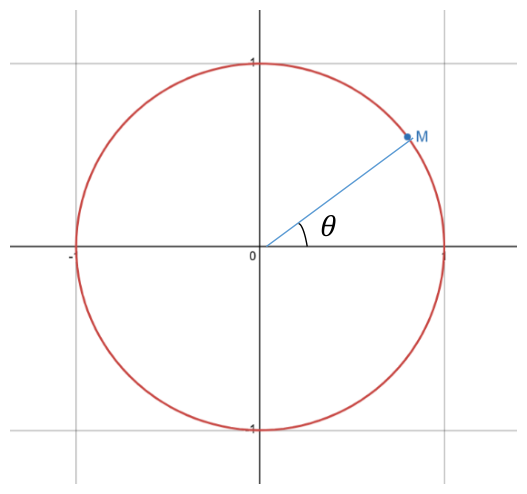
    In the diagram below, point M(45,35)M\left(\frac{4}{5}, \frac{3}{5}\right) is on the circle centered in the origin.

    What is the value of sin⁡θ\sin\theta?

    A circle centered at the origin of a coordinate grid, passing through 1 and -1 on both axes. A segment goes from the origin to point M on the circle in the first quadrant. The angle theta is marked between the positive x-axis and the segment to M.
    Show the answer

    Answer: 35\frac{3}{5}

    Solution: On a circle centered at the origin, sin⁡θ=yr\sin\theta = \frac{y}{r}. Here r=(45)2+(35)2=1r = \sqrt{\left(\frac{4}{5}\right)^2 + \left(\frac{3}{5}\right)^2} = 1, so sin⁡θ=35\sin\theta = \frac{3}{5}.

  2. Question 90

    In the diagram below, point M(45,35)M\left(\frac{4}{5}, \frac{3}{5}\right) is on the circle centered in the origin.

    What is the value of cos⁡θ\cos\theta?

    A circle centered at the origin of a coordinate grid, passing through 1 and -1 on both axes. A segment goes from the origin to point M on the circle in the first quadrant. The angle theta is marked between the positive x-axis and the segment to M.
    Show the answer

    Answer: 45\frac{4}{5}

    Solution: cos⁡θ=xr\cos\theta = \frac{x}{r} with r=1r = 1, so cos⁡θ=45\cos\theta = \frac{4}{5}.

  3. Question 91

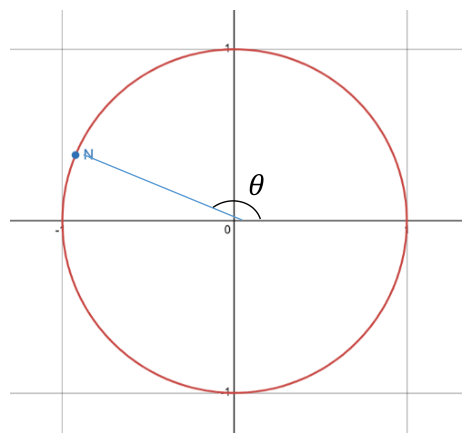
    In the diagram below, point N(−1213,513)N\left(-\frac{12}{13}, \frac{5}{13}\right) is on the circle centered in the origin.

    What is the value of sin⁡θ\sin\theta?

    A circle centered at the origin of a coordinate grid, passing through 1 and -1 on both axes. A segment goes from the origin to point N on the circle in the second quadrant, a little above the negative x-axis. The angle theta is marked from the positive x-axis counterclockwise to the segment to N, an obtuse angle.
    Show the answer

    Answer: 513\frac{5}{13}

    Solution: r=144169+25169=1r = \sqrt{\frac{144}{169} + \frac{25}{169}} = 1, so sin⁡θ=yr=513\sin\theta = \frac{y}{r} = \frac{5}{13}.

  4. Question 92

    In the diagram below, point N(−1213,513)N\left(-\frac{12}{13}, \frac{5}{13}\right) is on the circle centered in the origin.

    What is the value of cos⁡θ\cos\theta?

    A circle centered at the origin of a coordinate grid, passing through 1 and -1 on both axes. A segment goes from the origin to point N on the circle in the second quadrant, a little above the negative x-axis. The angle theta is marked from the positive x-axis counterclockwise to the segment to N, an obtuse angle.
    Show the answer

    Answer: −1213-\frac{12}{13}

    Solution: cos⁡θ=xr=−1213\cos\theta = \frac{x}{r} = -\frac{12}{13}; it is negative because NN is in the second quadrant.

Questions 97-100: sectors, radians and circumference

  1. Question 97

    In the figure below, the radius of the circle is 8 inches and m(∠AOB)=58∘m(\angle AOB) = 58^{\circ}. What is the area of the sector enclosed by the radii OA‾\overline{OA} and OB‾\overline{OB}? Round your answer to the nearest tenth.
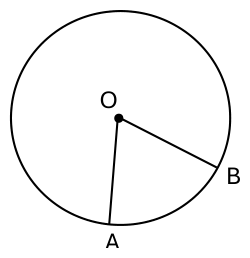
    A circle with center O. Two radii go from O to points A and B on the circle; A is near the bottom and B is on the lower right, forming the sector AOB.
    1. A. 30.630.6
    2. B. 31.531.5
    3. C. 32.432.4
    4. D. 33.833.8
    Show the answer

    Answer: C (32.432.4)

    Solution: Sector area =58360⋅π⋅82≈32.4= \frac{58}{360} \cdot \pi \cdot 8^2 \approx 32.4 square inches.

  2. Question 98

    In the figure below, the radius of the circle is 10 inches and m(∠AOB)=π3m(\angle AOB) = \frac{\pi}{3}. What is the area of the sector enclosed by the radii OA‾\overline{OA} and OB‾\overline{OB}? Round your answer to the nearest tenth.
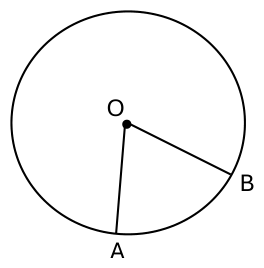
    A circle with center O. Two radii go from O to points A and B on the circle; A is near the bottom and B is on the lower right, forming the sector AOB.
    Show the answer

    Answer: 52.452.4 square inches

    About the printed key: The printed answer key gives 5.2. The area works out to 50π3≈52.4\frac{50\pi}{3} \approx 52.4, so the key has its decimal point in the wrong place.

    Solution: Sector area =12r2θ=12⋅102⋅π3=50π3≈52.4= \frac{1}{2} r^2 \theta = \frac{1}{2} \cdot 10^2 \cdot \frac{\pi}{3} = \frac{50\pi}{3} \approx 52.4 square inches.

  3. Question 99

    In the figure below, the radius of the circle is 17 inches and m(∠AOB)=1.2 radiansm(\angle AOB) = 1.2\ radians. What is the area of the sector enclosed by the radii OA‾\overline{OA} and OB‾\overline{OB}? Round your answer to the nearest tenth.
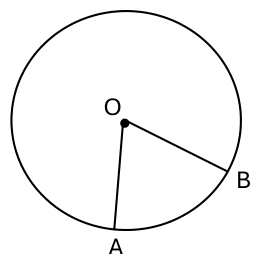
    A circle with center O. Two radii go from O to points A and B on the circle; A is near the bottom and B is on the lower right, forming the sector AOB.
    Show the answer

    Answer: 173.4

    Solution: Sector area =12r2θ=12⋅172⋅1.2=173.4= \frac{1}{2} r^2 \theta = \frac{1}{2} \cdot 17^2 \cdot 1.2 = 173.4 square inches.

  4. Question 100

    What is the circumference of the circle in the figure below? Round your answer to the nearest tenth.
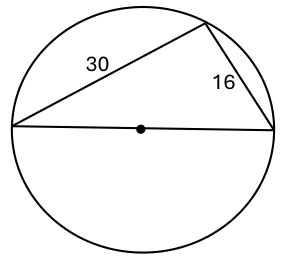
    A circle with its center marked by a dot. A diameter is drawn horizontally through the center. From the left end of the diameter a chord labeled 30 goes up to a point on the upper part of the circle, and from that point a chord labeled 16 goes down to the right end of the diameter, forming a triangle inscribed in the upper half of the circle.
    Show the answer

    Answer: 106.8

    Solution: The long chord passes through the center, so it is a diameter, and the angle inscribed in a semicircle is a right angle. The diameter is 302+162=34\sqrt{30^2 + 16^2} = 34, so the circumference is 34π≈106.834\pi \approx 106.8.

Questions 117-119: tangents to a circle

  1. Question 117

    In the figure below, AT‾\overline{AT} is a tangent to the circle. If AT=17AT = 17 and OA=24OA = 24, find the length of the radius OT‾\overline{OT}. Round your answer to the nearest tenth.
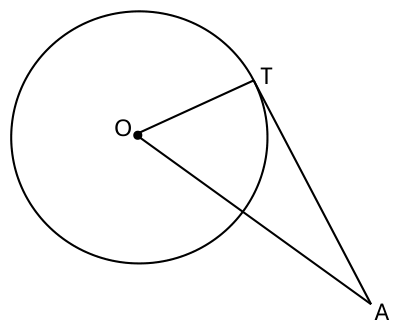
    A circle with center O. A radius goes from O to point T on the circle at the upper right. A tangent segment goes from T down to point A outside the circle at the lower right, and a segment connects O to A, forming triangle OTA.
    Show the answer

    Answer: 16.9

    Solution: A tangent is perpendicular to the radius at the point of tangency, so triangle OTAOTA has a right angle at TT: OT=242−172=287≈16.9OT = \sqrt{24^2 - 17^2} = \sqrt{287} \approx 16.9.

  2. Question 118

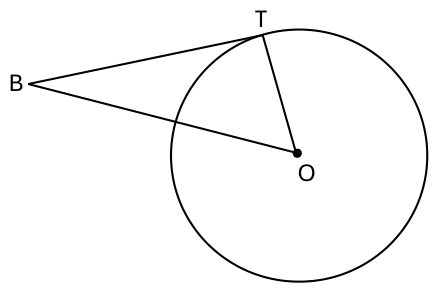
    In the figure below, BT‾\overline{BT} is a tangent to the circle. If OT=2x+3OT = 2x + 3, TB=3x−5TB = 3x - 5 and OB=97OB = \sqrt{97}, find the value of xx.

    A circle with center O. Point B is outside the circle to the left. A tangent segment goes from B to point T at the top of the circle, a radius goes from O up to T, and a segment connects B to O, forming triangle BTO.
    Show the answer

    Answer: x=3x = 3

    About the printed key: The printed answer key gives only the equation (2x+3)2+(3x−5)2=(97)2(2x + 3)^2 + (3x - 5)^2 = (\sqrt{97})^2. Solving it gives x=3x = 3; the other solution, x=−2113x = -\frac{21}{13}, would make both lengths negative.

    Solution: The radius OTOT is perpendicular to the tangent at TT, so (2x+3)2+(3x−5)2=97(2x + 3)^2 + (3x - 5)^2 = 97, which simplifies to 13x2−18x−63=013x^2 - 18x - 63 = 0, or (x−3)(13x+21)=0(x - 3)(13x + 21) = 0. The negative root makes both lengths negative, so x=3x = 3 (then OT=9OT = 9, TB=4TB = 4, and 81+16=9781 + 16 = 97).

  3. Question 119

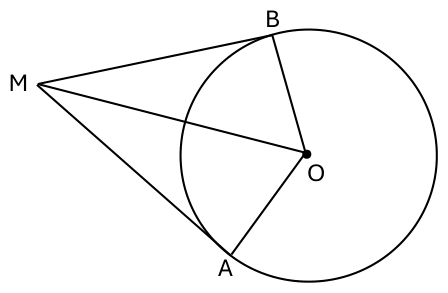
    In the figure below, MB‾\overline{MB} and MA‾\overline{MA} are tangents to the circle. If MB=27x−38MB = 27x - 38 and MA=13x+18MA = 13x + 18, find the value of xx.

    A circle with center O. Point M is outside the circle to the left. Tangent segments go from M to point B at the top of the circle and from M to point A at the bottom left of the circle. Radii connect O to B and O to A, and a segment connects M to O.
    Show the answer

    Answer: 4

    Solution: Two tangent segments from the same outside point are equal: 27x−38=13x+1827x - 38 = 13x + 18, so 14x=5614x = 56 and x=4x = 4 (both lengths are then 70).

Common questions

Are these real NC Math 3 EOC questions?
No. They are practice questions from the Successful Mathematics NC Math 3 EOC test-prep book. NC DPI publishes its own released Math 3 form on its End-of-Course (EOC) page.
Where are the rest of the questions?
The printed book holds 500 cumulative review questions covering the whole Math 3 course: questions 1-200 are find-the-answer items and 201-500 follow the multiple choice format of the End-of-Course test, with a complete answer key. The COGENT Math 2 & 3 course also ends with an End-of-Course Test Prep unit: 15 practice sets and a 40-question End-of-Course Exam.
Do I need an account to use these?
No. Every question, answer and solution on this page is free to read and use.